Iin never planned to build an empire. She just wanted her son's face to stop hurting.
She was born in Bukittinggi, a city cradled by volcanic hills in West Sumatra, where the air smells of cloves and the markets hum with the colors of local spices. It was a place that would quietly plant itself inside her — its traditions, its ingredients, its rhythms — long before she knew what she'd do with any of it.
She grew up, studied accounting, married Ardi, and made a home. Two children came — Andra and Rizky — and for a time, that was the whole world. The kitchen, the school runs, the particular mathematics of family life. She was good at it. She was also, quietly, restless.
Then the suitcases came out.
Ardi's work with Schlumberger meant the family didn't stay anywhere long. Every two years or so, a new country, a new city, a new everything. Melbourne first, then Perth. Then California, then Dallas. Then the heat and energy of Lagos and Port Harcourt in Nigeria. Then Baku, Azerbaijan, where the Caspian Sea glitters at the edge of a city that feels like three centuries living in the same neighborhood. Then Tripoli. Each move came with its own version of culture shock — new languages half-learned, new customs navigated, new school for the children, new way of buying vegetables, new understanding of what normal meant.
Most people would have been exhausted. Iin was, sometimes. But she was also surprisingly good at it. She had a warmth that opened doors, a genuine curiosity about people that made strangers feel like old friends. What almost no one guessed was that she considered herself an introvert at heart — someone who, given the choice, would quietly close the door and lose herself for hours in whatever she was making. The socializing was real, but so was the deep relief of being alone with her hands and her thoughts.
And so the jobs weren't restlessness. They were adaptation. In each new city, she found a way in — a role that made sense in that place, at that time. At Schlumberger she worked as an assistant recruiter, then slid into publishing their internal newspapers, ASA News and Caspian News, writing and editing in the in-between hours. When the next move came, she reinvented again. She taught herself to dye knitting yarn by hand, watching skeins bloom into color, selling them to crafters who couldn't believe what they were seeing. She learned crochet, then began writing patterns for it — the precise and loving language of loops and stitches. Her strawberry crochet motif caught the eye of Australian Homespun magazine. Her patterns found a home on Ravelry, discovered by hands in countries she'd never visited.
Somewhere in there, she picked up a camera. Then another course — photography techniques, studied through the New York Institute of Photography. Getty Images eventually came calling. The accountant-turned-recruiter-turned-publisher-turned-yarn-dyer was now a photographer whose images moved through the world's largest stock library.
What looks, from the outside, like a scattered collection of careers was really something else entirely: a woman finding her footing, again and again, in soils that kept changing beneath her feet.
But it was her son's skin that changed everything.
Rizky had always struggled — sensitive, acne-prone, reactive to almost everything the pharmacy shelves had to offer. Iin did what mothers do: she researched, she read, she refused to accept nothing works as a final answer. She enrolled in an organic skincare diploma at the Centre of Excellence in Manchester. She went back to what she knew from childhood — the gambir leaf used for generations across Sumatra, the deep green of moringa, the red blush of secang wood, the quiet power of green tea. She began formulating in her kitchen, the same kitchen that had once been full of yarn dye and crochet hooks.
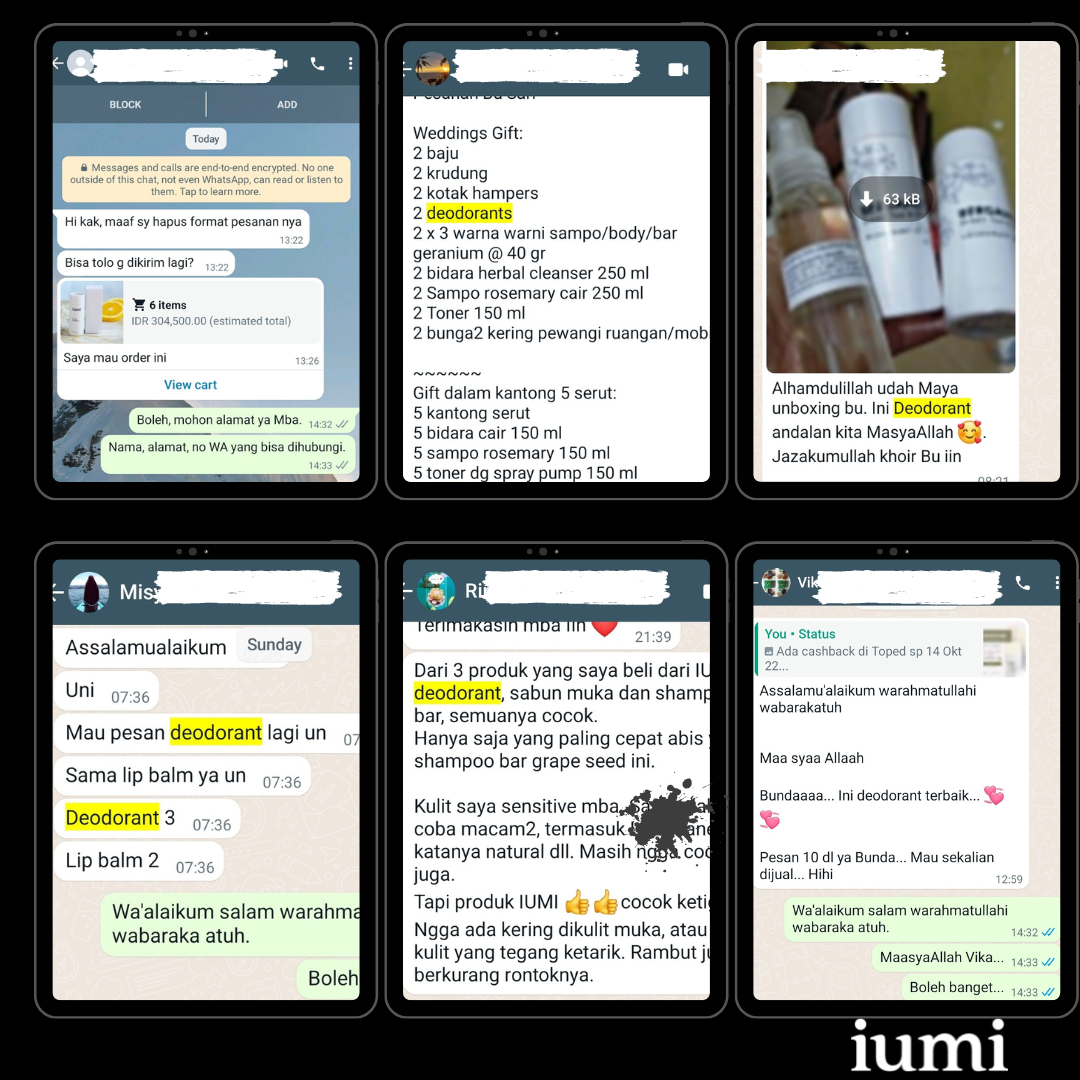
What she made worked. And then other people wanted it.
Only later, looking back, did it crystallize: making cosmetics had always been the dream. It had been there the whole time, half-hidden beneath the accounting textbooks and the yarn and the camera lenses — a thread she'd been following without knowing its name. What she hadn't known, what nobody had told her, was that you didn't need a factory or a lab or a storefront. You could build it at home. You could build it around your children, around your faith, around the ingredients your grandmother's generation already knew were powerful.
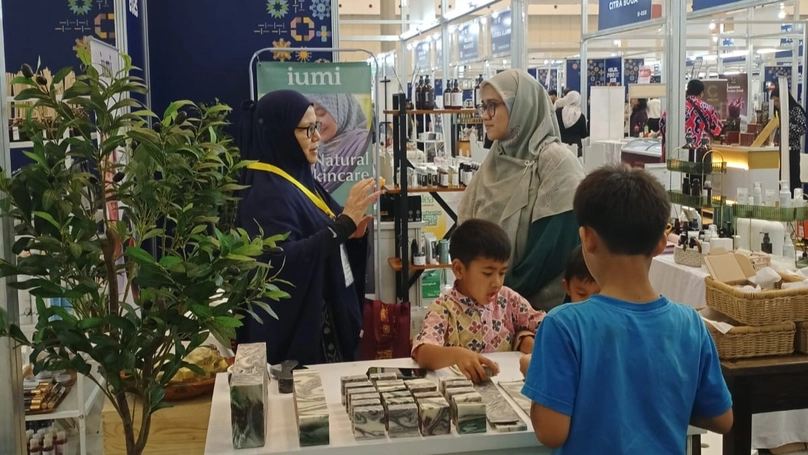
IUMI was born not from a business plan but from a mother's frustration and a culture's inherited wisdom. The name carries meaning; the brand carries values. Everything Iin makes is halal, eco-conscious, rooted in local raw materials, and honest in a way she considers an extension of her faith. No false promises, she tells anyone who will listen. No chasing trends. Only solutions. The products are designed for skin aged 10 to 65, because sensitivity doesn't check your birth certificate.
IUMI has since won awards, been recognized in national competitions, and earned a reputation that has pulled Iin into classrooms and community halls — teaching housewives, mentoring students, running workshops. The brand's CSR work reaches into pesantren, supports local farmers who grow the ingredients she uses, and tries to leave something good behind.
She is an entrepreneur, a photographer, a pattern-maker, a formulator, a mentor, and a mother. She has lived on four continents and unpacked her suitcase in more cities than most people visit in a lifetime. She is Irtati Wibisono — Iin to almost everyone — and she is proof that a life doesn't have to follow a straight line to arrive somewhere meaningful.
She started by listening to her son. She ended up hearing something she'd been trying to say all along.